
Checking Criminal History in Bremen
A Bremen criminal-record search begins with the office that created the record. Bremen Police holds city incident and accident reports, Municipal Court holds citations and dispositions, and the receiving county jail holds booking data. Because Bremen crosses the Carroll-Haralson line, a city name alone cannot select the right county. Match the incident location, arresting agency, receiving jail, and issuing court before relying on a result.
- Confirm Bremen Police responded and note the event date, location, report number, and names.
- Request the exact police product, such as an incident report, accident report, or local history check.
- Contact Bremen Municipal Court for a citation, case status, or certified disposition.
- Use Carroll or Haralson booking and court channels according to the event location and paperwork.
- Use a Georgia Crime Information Center personal review when a fuller statewide history is needed.
Three Days and Two Report Prices
Bremen publishes concrete service prices, but two official statements differ. The detailed service page lists an accident report at $5 and an incident report at $3. A general FAQ says all reports cost $5 and advises allowing at least three days for processing. Identify the report type and call 770-537-4441 before traveling. The processing allowance is not a guarantee that every item is releasable; protected information or an active investigation can affect access.
Bremen Police Department Records
Bremen Police operates from the Public Safety Complex at 191 Georgia Avenue North. The counter is open Monday through Friday, 8:00 a.m. to 6:00 p.m.; non-emergency dispatch is 770-646-0077. The department describes 21 full-time and one part-time employees, Patrol, Traffic, K-9, and Criminal Investigations divisions, and four 12-hour watches serving 10.52 square miles. Bremen remains custodian of its report even when custody or prosecution moves elsewhere.
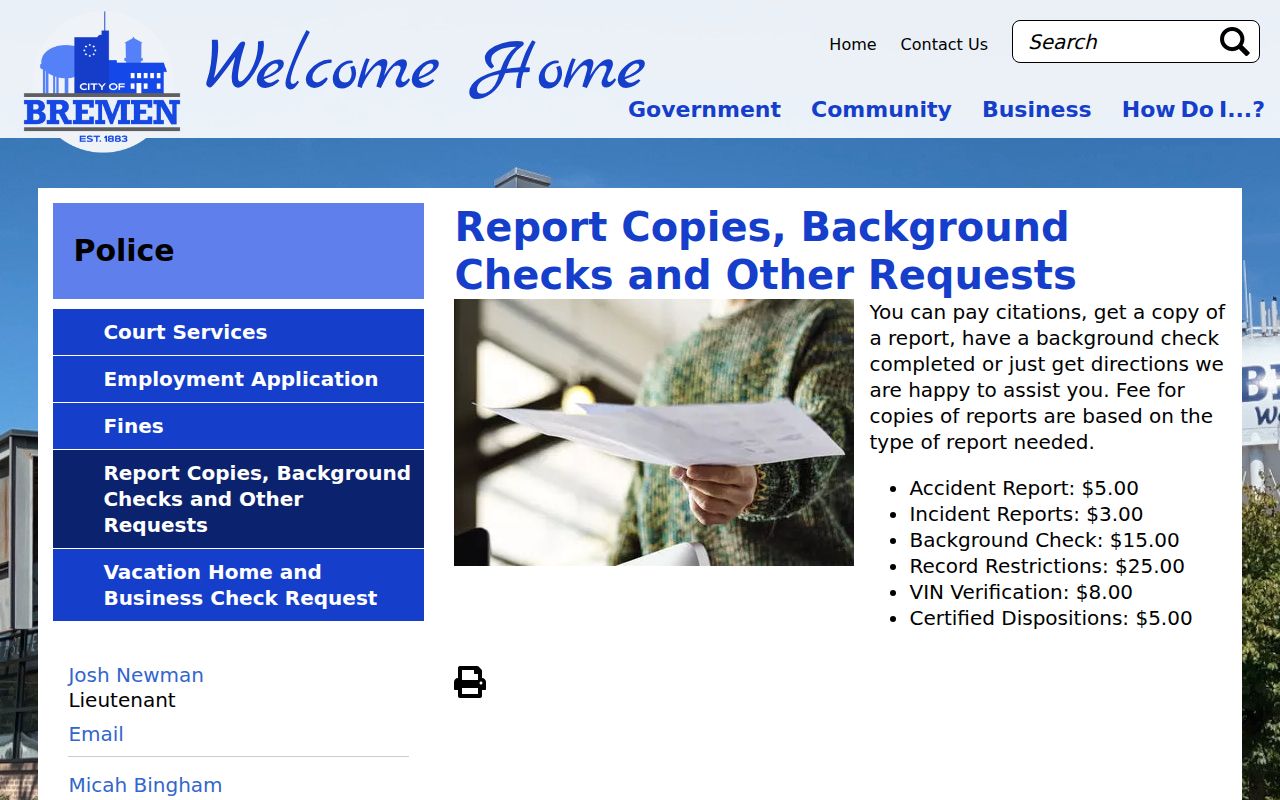
The official schedule lists $5 for an accident report, $3 for an incident report, $15 for a local criminal history, $25 for record-restriction processing, $8 for VIN verification, and $5 for a certified disposition. Photo identification is required for the local history check. Give a narrow date, location, report number, parties, and the exact components sought. An initial report, supplements, photographs, audio, and video are not interchangeable.
The $15 Bremen Local History Check
The local criminal-history check is a city product and should not be treated as a nationwide screening report or a complete Georgia record. Its scope depends on local records and lawful identifiers. A person seeking a fuller fingerprint-linked Georgia history should use GCIC's personal-review process. For a particular event, the police report and final court disposition may answer more precise questions than a general local check.
A name match alone does not establish identity. Confirm results with date of birth or other identifiers accepted by the official office, and verify a final outcome with the court that entered it. No Bremen result does not prove the absence of Carroll County, Haralson County, or statewide history.
Bremen Arrests and Bookings
A Bremen Police report stays with the city, but custody data follows the receiving jail. Establish where the arrest occurred and which jail received the person. A Carroll-side arrest points to Carroll County Sheriff's custody channels; a Haralson-side event may route to Haralson County. Whole-city population figures cannot settle jurisdiction.
A booking entry records custody, intake charges, booking time, and then-current bond information. It is not proof of guilt, and intake charges can differ from charges later filed. The incident report explains the police response, while the final court disposition explains the outcome. Record the date and time of searches because systems update at different speeds.
Bremen Crosses the County Line
Bremen's 2025 whole-place estimate is 7,751 residents, but the figure includes both counties and does not allocate a particular incident. Use the street address, responding agency report, booking sheet, citation, or court notice. The trail can split across offices without changing the city custodian: police keeps the report, a county keeps booking data, and the proper court keeps the filed case.
Preserve report, booking, citation, and case numbers as the search moves among offices. These identifiers are more reliable than names alone and help distinguish a municipal citation from a state prosecution.
Municipal Court Records in Bremen
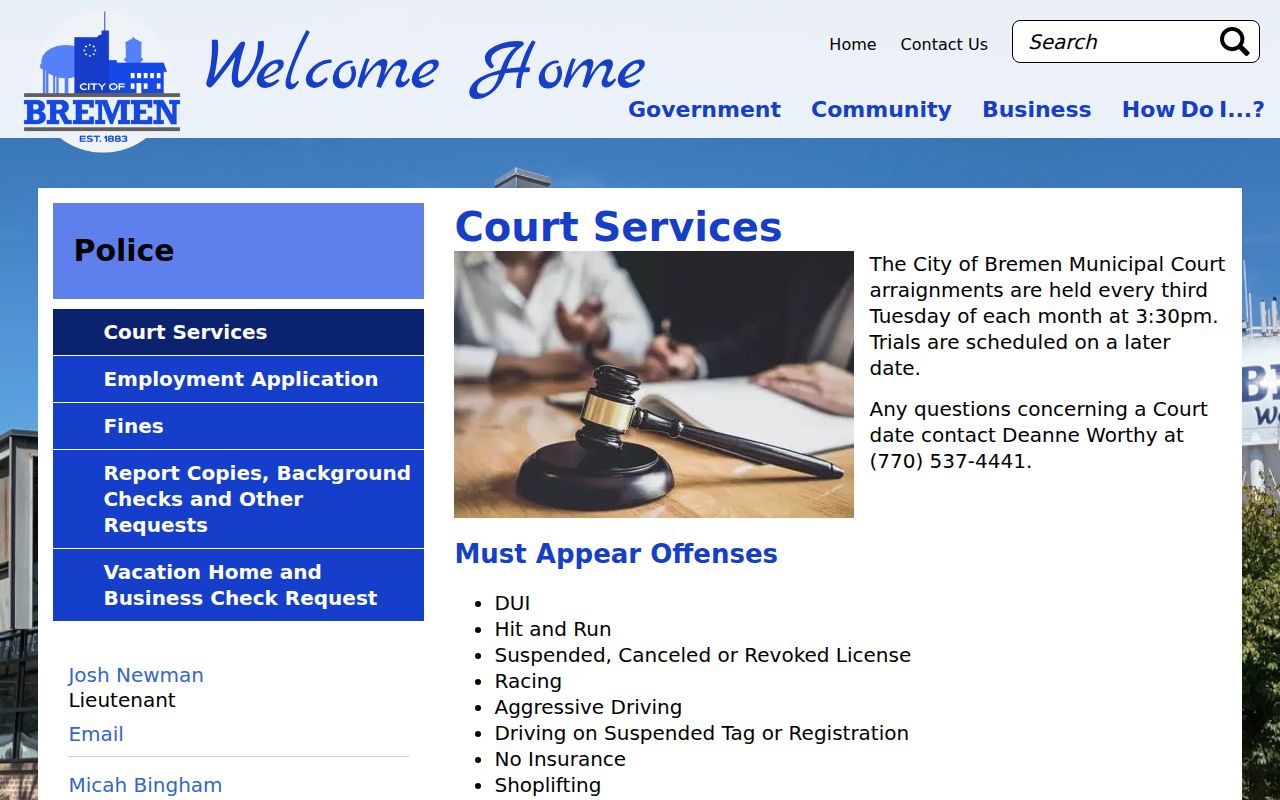
Bremen Municipal Court shares the Public Safety Complex with police. Arraignments occur on the third Tuesday monthly at 3:30 p.m. The court handles city citations and matters within municipal jurisdiction. Must-appear categories include DUI, hit-and-run, suspended or revoked licenses, racing, aggressive or reckless driving, no insurance, shoplifting, specified drug and underage-alcohol matters, serious speeding, and other published violations.
| Court Name | Bremen Municipal Court, 191 Georgia Avenue North |
|---|---|
| Case Types Heard | Municipal ordinance, traffic, and qualifying misdemeanor matters |
| Case Lookup Channel | Municipal court clerk; BremenPay is payment, not a name index |
| What the Docket Shows | Citation, charge, setting, plea, disposition, and payment data as applicable |
| Copies & Fees | Certified disposition $5; confirm other copy charges with the clerk |
Must-Appear Charges and Court Rules
BremenPay resolves eligible citations but is not a public case-history search. Published in-person payment methods are cash, cashier's check, or money order. Mailed payments use cashier's check or money order; personal checks are not accepted. The fine table labels its figures cash-bond amounts and states that a property bond is double. Those are not record-copy fees.
Court rules prohibit phones, pagers, and noise-producing devices even when turned off. Published grounds for a court-date extension are narrow: incarceration, hospitalization, or a simultaneous appearance in another court. Contact the clerk for current instructions. A records request neither extends a deadline nor excuses an appearance.
Where Bremen Records Go
A city event creates records at different times. Bremen Police creates the report, a receiving jail creates booking data, and Municipal Court keeps city citations. A state charge may be filed in Carroll or Haralson court. Fingerprint-supported arrest and disposition data can ultimately reach GCIC, but local sources remain essential when a state entry is incomplete.
Record flow: Bremen Police › Carroll or Haralson booking and court channels › Georgia Crime Information Center
For recent activity, begin with police and the receiving jail because prosecutors may not yet have filed a case. For older matters, obtain the court's final disposition. To correct GCIC data, gather documentation from the arresting agency, prosecutor, or court; the originating source must transmit the correction.
A $5 Certified Disposition
A certified municipal disposition is often more useful than a payment receipt because it states the official result. Ask whether the clerk can locate the matter by citation number, full name, and date of birth, and specify certification. Depending on the case, the document may show a plea, dismissal, conviction, sentence, or another final action.
A disposition does not replace the police report, which can remain a separate record after dismissal. If the case left municipal jurisdiction, follow the clerk's referral to the proper county court. Verify the caption, number, filing court, and disposition date before using the record to distinguish people with similar names.
Building a Precise Bremen Request
A well-scoped request helps Bremen staff locate the right material and helps the requester understand the resulting fee. Start with the agency report number when available. Add the event date, an approximate time, the street or business location, the names shown on the report, and a short description of the event. Then name each desired component. The initial incident narrative, supplemental narratives, accident diagram, photographs, body-camera recording, dispatch audio, and certified court disposition are separate records. Asking for “everything” without a date range or event identifier can increase search time and may produce records that do not answer the question.
Choose the office by function. Police is the source for a Bremen officer's incident or accident report and the published local-history service. Municipal Court is the source for city citation status and the $5 certified disposition. The receiving sheriff is the source for a jail booking, release, or bond status. A county clerk is the source for a later filed state prosecution. Sending the same broad request to every office does not create a more complete history; it can create duplicate responses and confusion about which document is authoritative.
Timing also changes the best route. Immediately after an arrest, police and jail records may exist before a prosecutor has made a filing decision. A municipal citation may have a future arraignment date but no final disposition. After the case ends, the court's certified disposition becomes the strongest evidence of the result. If a statewide GCIC record later lacks that result, use the certified disposition when working with the originating court, prosecutor, or arresting agency on a correction. Keep copies of responses and note when each search was performed.
Fees should be confirmed before the visit because Bremen's specific service list and general FAQ differ on incident-report pricing. Ask whether the requested report is treated as an incident report or accident report, whether identification is required, whether certification is available, and which payment methods the records counter accepts. Do not confuse Municipal Court's cash-bond table with public-record copy charges. A quoted bond, fine, or citation payment addresses the case, while a copy fee purchases a document.
Finally, account for confidentiality and identity limits. An agency can redact material protected by Georgia law, including sensitive victim or minor information and portions tied to an active investigation. A local criminal-history check does not necessarily reveal activity maintained by another city, another county, or a statewide or federal system. Conversely, a name appearing in a report does not establish that the person was arrested, charged, or convicted. Read the role assigned to the name and corroborate it with the filed case and disposition. When the purpose carries legal or personal consequences, obtain the record directly from the maintaining office and seek qualified advice about its meaning.
Public Access Rules in Bremen
The Georgia Open Records Act generally presumes agency records open unless an exemption applies. An agency must produce available records within three business days or provide a written timetable, estimated cost, and legal basis for withholding. That response rule differs from Bremen's advice to allow three days for report processing. Protected personal data, victim and minor information, and active-investigation material may be redacted.
Key Statutes:
Georgia Open Records Act, O.C.G.A. § 50-18-70 et seq. - Records are presumed open unless a specific exemption permits withholding.
Georgia Code § 50-18-71 - Agencies must respond within three business days and may assess lawful costs.
Georgia Code § 35-3-37 - Eligible arrest-cycle data may be restricted without destroying every source record.
Bremen lists restriction processing at $25, but eligibility depends on arrest date and outcome. Restriction, court sealing, and obtaining a copy are distinct processes. A restricted GCIC entry can coexist with a police report or court file governed by separate rules. Confirm the current process with the responsible agency or prosecutor.